Business document template
Write a customer case study with a measurable outcome
Show how you helped a customer, with results and quotes.
Make this with my informationOpens an editable creation brief. Nothing runs until you submit.
- Format
- Business document
- Last updated
- August 31, 2026
- You bring
- 3 inputs
- By
- Huggle Editorial
The creation brief
This template is for marketers and consultants who have a real result and need a story sales can send. Huggle writes the narrative from approved facts only.
Creation recipe
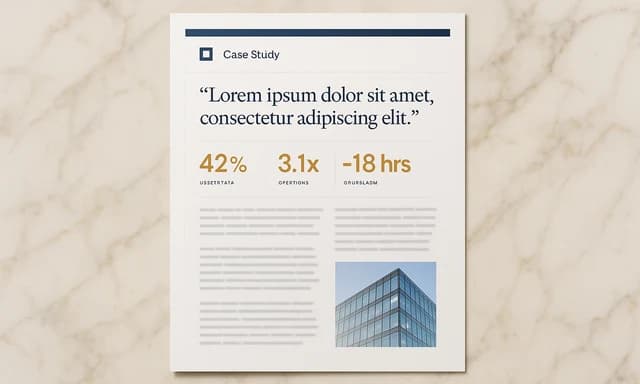
Create a customer case study for a fictional fitness chain ‘Alder’ that used a local-marketing program. Use only these demo results: 18,400 members, referral share from 22% to 31% in 90 days, and churn from 4.1% to 3.6%. Structure: customer snapshot, problem, approach, results table, quote labeled as demo, and next steps. Do not invent extra metrics or logos.
What Huggle creates
- Case study with snapshot, problem, approach, and results
- A results table and a clearly labeled demo quote
- A closing CTA for the next prospect
What to bring
- 01Customer context you are allowed to publish
- 02The work you did and the metric that moved
- 03A quote you have permission to use, or none
Overview
What is a customer case study?
A customer case study is a short narrative of a real engagement: who the customer was, what was broken, what you did, and what changed. It is a sales asset, not a testimonial blurb. An AI case study generator should refuse extra metrics you did not supply.
What's included
What this AI case study generator writes
Customer snapshot and problem
Open with who they are and why they hired you. The Alder example is a 12-location fitness chain with weak referrals. Your snapshot should use only facts the customer has cleared. If you cannot name the company, describe the segment and keep the metric.
Approach
What you did, in the order a skeptical buyer can follow. Skip tool lists. Name decisions. This is the section that separates a case study from a quote.
Results table
Put the before/after in a table. The demo moves referral share from 22% to 31% and churn from 4.1% to 3.6% in 90 days. Your table should use the one or two metrics you can defend. Case studies rank among the highest-performing B2B content in CMI’s research precisely because of defensible numbers like these.
Quote and next-step CTA
A quote is optional and must be approved. The example quote is labeled demo. Close with the kind of company that should talk to you next.
Comparison
Huggle vs. a generic case study template
Most templates are headings. This generator writes the story from the outcome you can prove.
| Criterion | Huggle | Static template |
|---|---|---|
| Starting point | A complete draft with snapshot, approach, and results table | Empty Challenge / Solution / Results boxes |
| Metrics | Only the numbers you provide, in a table | Placeholder 200% ROI you might forget to replace |
| Quotes | Omitted or labeled until you have permission | A fake name already in the file |
| Revision | Ask Huggle to shorten it for a one-pager or a deck | Manual rewrite for each channel |
Sources
Sources and benchmarks
- In Content Marketing Institute’s 2025 B2B benchmarks, 75% of B2B marketers used case studies or customer stories, and 53% named them among the content types delivering their best results. Content Marketing Institute, B2B Content Marketing 2025
How it works
From example to your finished artifact
- 01
Start from the proven recipe
Open Huggle with the complete creation brief already in the composer.
- 02
Add your context
Answer a few focused questions so the structure, content, and visual direction fit your situation.
- 03
Create and refine
Generate an editable artifact, then ask Huggle to revise it until it is ready to use.
Use the recipe
Make a version that belongs to your work.
Huggle will ask for the missing context, then create an editable document you can keep refining.
Frequently asked questions
- What is an AI case study generator?
- It turns approved customer facts into a structured case study. Huggle writes the narrative and the results table; you still own legal review and quote permission.
- What should a customer case study include?
- A snapshot, the problem, the approach, a results table, an optional quote, and a next-step CTA. That is this template’s outline.
- Can I publish a case study without naming the customer?
- Yes. Describe the industry and size, keep the metric, and skip the logo. Many B2B buyers accept anonymized studies if the numbers are specific.
- How long should a case study be?
- Long enough for the result and short enough to email. Aim for 600–900 words or a two-page layout. This template stays in that range.
- Will Huggle invent extra results?
- No. The brief allows only the metrics you supply. If you have one number, the table has one number.
- Is the document editable after it is generated?
- Yes. You can tighten the approach section or ask Huggle to produce a slide version with the sales-deck template.
- What information do I need to bring?
- Bring publishable customer context, the work you did, the metric that moved, and a quote only if you have permission.
- How do I use this case study template?
- Open Huggle with the creation brief in the composer, replace Alder with your cleared facts, and submit. Legal-review quotes before you post.
Related templates
2 artifacts
Client strategy proposal
Present your plan, scope, and pricing in a client proposal.
B2B sales deck
Present your product, customer results, and offer to a buyer.
Also explore consulting proposal template with diagnosis and pricing tiers and B2B sales deck template for first calls.