AI research paper generatorLaTeX papers that compile, with citations
Huggle's AI research paper generator turns your research question, notes, results, and sources into a structured academic paper in LaTeX: abstract, introduction, method, results, discussion, figures, tables, and a bibliography in the citation style you name. The paper compiles to PDF inside your workspace and stays editable, so you revise a section or fix a citation in place instead of pasting model output into Overleaf. Huggle works from the material you provide and cites sources you supply or that it finds through research; it does not invent studies or results.
Free to start, no card required. Paid plans from $10 a month with every frontier model included. See pricing.
01What you get
What Huggle's AI research paper generator produces
A finished research paper you can open, edit, and share, not raw model output you still have to assemble somewhere else.
LaTeX that compiles
Huggle writes the full document, from preamble and packages to sections, floats, and bibliography, and compiles it to PDF in the workspace. Compile errors are fixed in the same turn rather than handed back to you.
Structure from your material
Paste notes, results, and an outline and Huggle organizes them into the sections your field expects: IMRaD for empirical work, or the structure your venue's template requires.
Citations and BibTeX you can check
Sources you provide become a BibTeX bibliography and correctly placed in-text citations in APA, IEEE, Chicago, Harvard, or another style. Anything Huggle finds through research is cited with a link so you can verify it.
Tables and figures from your data
Results tables are built from your numbers with booktabs formatting, and figures are placed with captions and labels you can reference. Assumptions and missing data are marked, never filled in.
02Examples
What people generate with the AI research paper generator
Each example is a prompt you can open in the composer as written. Huggle asks for the details it needs before it builds anything.
Empirical research paper
01An IMRaD paper with a results table built from your data, figures with captions, and a bibliography in your target style.
Undergraduate or master's thesis
02Chapters, a table of contents, front matter, and consistent citations across a long document that still compiles.
Lab report
03Objective, apparatus, procedure, results with uncertainty, analysis, and conclusion, formatted the way STEM courses expect.
Literature review section
04A thematic synthesis of the papers you supply, with the gaps stated and every claim attached to a citation.
03How it works
From a sentence to a finished research paper
Four steps, one workspace. The file is real from the first pass and stays editable for as long as you keep working on it.
- Step 1
Describe the outcome
Write a sentence or two about what you need, who it is for, and the facts you already have. Or open a template and swap in your own situation.
- Step 2
Answer a few questions
Huggle asks for the missing details it needs, such as audience, scope, numbers, and tone, so the first draft is specific to you rather than a generic template.
- Step 3
Watch the file take shape
Pick Flash for speed or Max for power. Huggle routes across frontier models and builds the artifact as a real file in the preview surface.
- Step 4
Edit, then share or export
Revise in place, ask Huggle to change a section, then share a link or export. The file stays editable; there is no transcript to copy out of.
04Comparison
Huggle vs. a chat app plus Overleaf
| Criterion | Huggle | Chat app plus a LaTeX editor |
|---|---|---|
| What you get | A complete LaTeX project that compiles to PDF, with bibliography and floats | Fragments of LaTeX in a chat window that you assemble and debug in Overleaf |
| Compile errors | Huggle compiles the paper and fixes errors in the same turn | You read the log and paste the error back into the chat |
| Citations | BibTeX entries and in-text citations in your style, from sources you can verify | Citations typed by hand, or generated text that has to be checked one by one |
| Tables and figures | Built from your data with captions, labels, and booktabs | Formatted manually or via a separate table tool |
| Revisions | Ask for a change to one section; the project updates in place | Regenerate, copy, and merge the change by hand |
| Models | Every frontier model included; choose Flash or Max per task | One vendor's model |
05Finished examples
Start from a research paper Huggle already made
Generate structured LaTeX source and compiled academic documents with equations, figures, and references. Every template opens the full brief in the composer so you swap in your own situation.

Compiled LaTeX paper
Async status research paper
Go from a plain-English study brief to editable LaTeX with a results table, figure, equation, references, and compiled PDF.
Open template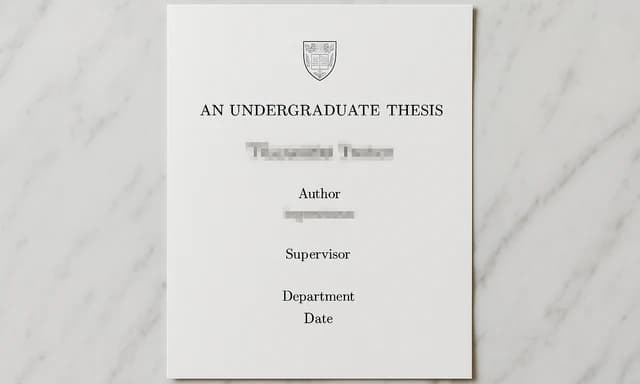
Compiled LaTeX thesis
Undergraduate thesis
Turn a thesis outline into editable LaTeX with chapters, figures, bibliography, and a compiled PDF.
Open template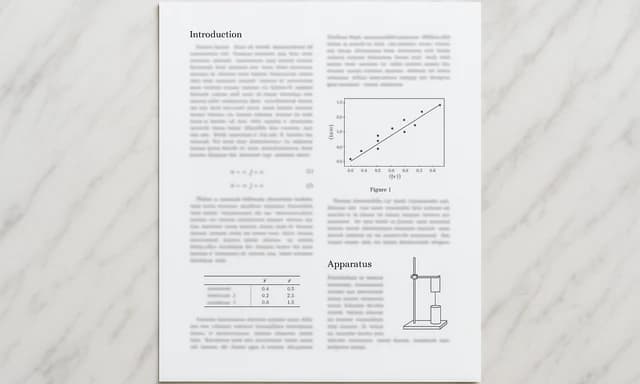
Compiled LaTeX report
STEM lab report
Turn a lab notebook into a compilable report with methods, a results figure, uncertainty, and references.
Open template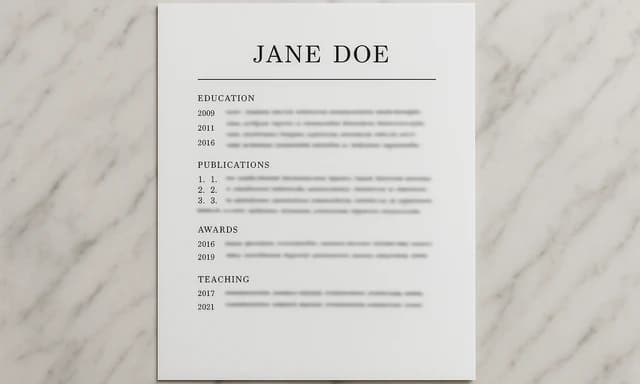
Compiled LaTeX CV
Academic CV
Turn your appointments, papers, and teaching into a compact academic CV in editable LaTeX.
Open template06FAQ
AI research paper generator questions
01Does the AI research paper generator write the research for me?
No. Huggle structures, drafts, and formats a paper from the research question, notes, results, and sources you provide. It will not invent experiments, data, or references, and it marks any place where it needs information you have not given. You remain responsible for the science and for following your institution's rules on AI assistance.
02Are the citations real?
Citations come from sources you supply or from web research that Huggle links so you can check it. Each becomes a BibTeX entry and an in-text citation in your chosen style. Verify every reference against the original before submitting; the free citation generators on Huggle help with individual entries.
03Which citation styles are supported?
APA, MLA, Chicago, IEEE, Harvard, AMA, ACS, CSE, Turabian, and ASA, through BibTeX and the matching LaTeX bibliography style. Name the style in your prompt or ask Huggle to switch styles after the draft exists.
04Can I use my journal or university template?
Yes. Paste or upload the template's class file and instructions and Huggle drafts into that structure. For common venues, ask for the format by name and check the result against the venue's author guidelines.
05Can I download the LaTeX source and the PDF?
Yes. The project is real LaTeX source, so you can export the .tex and .bib files to Overleaf or a local TeX installation, and download the compiled PDF.
06Is there a free plan for research papers?
Yes. A free Huggle account includes an allowance with no card required, enough to draft and compile a first paper. Paid plans start at $10/month launch pricing and include every frontier model.
Try the AI research paper generator
Describe the work once. Edit the file the moment it lands.
Start free with no card. Documents, decks, spreadsheets, LaTeX, databases, and websites, every frontier model included, from $10 a month when you upgrade.