Business document template
Write a one-page business plan investors can scan
Summarize your idea, customers, costs, and next steps.
Make this with my informationOpens an editable creation brief. Nothing runs until you submit.
- Format
- Business document
- Last updated
- August 31, 2026
- You bring
- 3 inputs
- By
- Huggle Editorial
The creation brief
This template is for founders who need a plan someone will actually read. Huggle compresses your facts onto one page — not a 30-page plan nobody opens.
Creation recipe
Create a one-page business plan for ‘Harbor,’ a fictional inbox for client feedback aimed at freelance designers. Include problem, solution, customer, unfair advantage, pricing, simple unit economics, channels, 90-day milestones, and risks. Use a single-page layout with tight headings. Do not invent market size; label demo figures as founder-provided.
What Huggle creates
- One-page plan covering offer, customer, and economics
- 90-day milestones and named risks
- No invented TAM or traction
What to bring
- 01Problem, customer, and the offer
- 02Pricing and any real traction
- 03What you will do in the next 90 days
Overview
What is a one-page business plan?
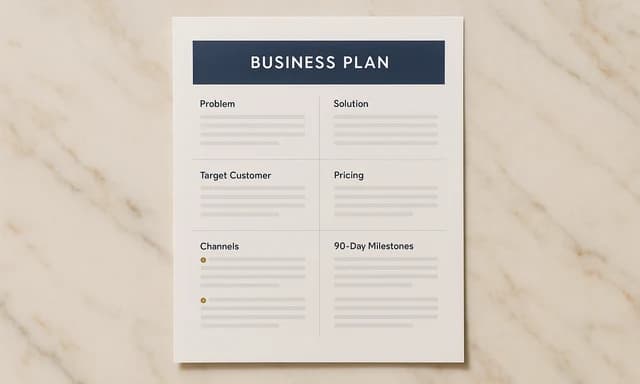
A one-page business plan is a single-sheet summary of the problem, customer, offer, economics, and near-term plan. It is meant to be scanned in a meeting, not filed. An AI business plan generator should fill those blocks from your facts and refuse invented market size.
What's included
What this AI business plan generator writes
Problem, customer, and offer
The top of the page states who has the problem and what you sell. Harbor in the example is an inbox for freelance designers. Your version should be equally concrete. If you cannot name a customer, you do not have a plan yet.
Pricing and simple unit economics
Price, what it costs to deliver, and whether a single customer is worth acquiring belong on the page. Pair this document with the SaaS cash-flow model when you need month-by-month math. HBR’s finding that planners are 16% more likely to reach viability is about this kind of concrete cash thinking, not a vision paragraph.
Channels and 90-day milestones
How you will find the next ten customers, and what will be true in 90 days. Milestones should be observable. ‘Get famous’ is not a milestone. ‘Ten paid designers using weekly’ is.
Risks without theater
Name the two or three ways this fails. Huggle will not invent a TAM slide. A one-page plan should stay one page so it gets read — and revisited.
Comparison
Huggle vs. a 30-page business plan template
Classic plan templates pad to look complete. This generator writes a page someone can finish before the meeting starts.
| Criterion | Huggle | Static template |
|---|---|---|
| Length | One page with the decisions that matter | A 20–40 page outline from LivePlan or SCORE |
| Market size | Omitted unless you supply a sourced number | A TAM/SAM/SOM block that invites invention |
| Next actions | A 90-day milestone list | A five-year narrative |
| Revision | Ask Huggle to retarget the customer or pricing | Manual Word edits across many sections |
Sources
Sources and benchmarks
- Research published in Harvard Business Review found that entrepreneurs who write formal plans are 16% more likely to achieve venture viability than otherwise identical non-planners. Harvard Business Review, “Research: Writing a Business Plan Makes Your Startup More Likely to Succeed”
How it works
From example to your finished artifact
- 01
Start from the proven recipe
Open Huggle with the complete creation brief already in the composer.
- 02
Add your context
Answer a few focused questions so the structure, content, and visual direction fit your situation.
- 03
Create and refine
Generate an editable artifact, then ask Huggle to revise it until it is ready to use.
Use the recipe
Make a version that belongs to your work.
Huggle will ask for the missing context, then create an editable document you can keep refining.
Frequently asked questions
- What is an AI business plan generator?
- It turns a founder brief into a structured plan. This template keeps the output to one page so the plan can be used in a conversation, not as a binder.
- What should a one-page business plan include?
- Problem, customer, offer, pricing, simple economics, channels, 90-day milestones, and risks. That is the outline this template uses.
- Is a one-page plan enough for investors?
- It is enough to start the conversation. Pair it with a pitch deck and a runway model when you are fundraising. It is not a substitute for diligence.
- Will Huggle invent market size?
- No. The brief says not to invent TAM. If you have a sourced figure, bring it. If you do not, the page stays quieter and more credible.
- Can I expand it later?
- Yes. Generate the one-pager first, then ask Huggle for a longer memo or use the pitch-deck template for slides.
- Is the document editable after it is generated?
- Yes. Edit any block or ask Huggle to rewrite the 90-day plan.
- What information do I need to bring?
- Bring the problem, customer, offer, pricing, any real traction, and what you will do in the next 90 days.
- How do I use this one-page business plan template?
- Open Huggle with the creation brief in the composer, replace Harbor with your company, and submit. Keep it to one page when you export.
Related templates
2 artifacts
Startup pitch deck
Pitch your startup in 12 slides with traction and funding needs.
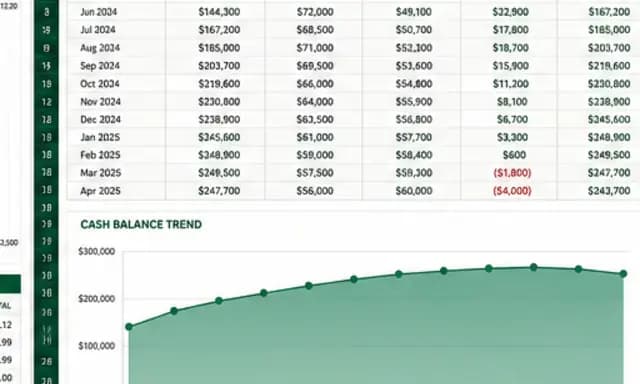
SaaS cash-flow and runway model
Forecast cash flow and runway with editable assumptions and formulas.
Also explore startup pitch deck template for fundraising and SaaS financial model template with 24-month runway scenarios.