Presentation deck template
Build a startup pitch deck investors can follow
Pitch your startup in 12 slides with traction and funding needs.
Make this with my informationOpens an editable creation brief. Nothing runs until you submit.
- Format
- Presentation deck
- Last updated
- August 31, 2026
- You bring
- 3 inputs
- By
- Huggle Editorial
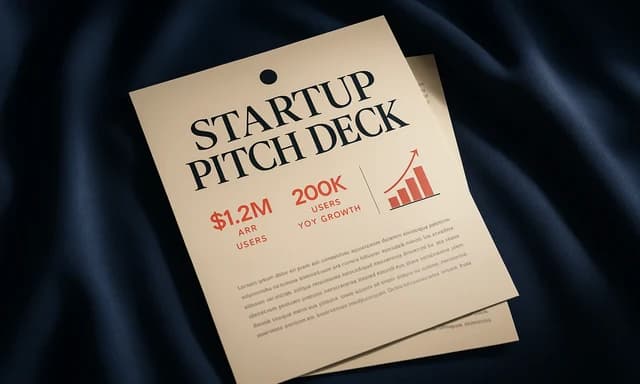
The creation brief
This template is for founders who need a fundraising narrative, not a theme. Huggle writes a 12-slide arc from facts you can substantiate and labels everything else as assumption.
Creation recipe
Create a 12-slide startup pitch deck for ‘Harbor,’ a fictional inbox for client feedback. Slides: title, problem, solution, product, customer, market only if sourced, model, go-to-market, traction labeled demo, team, ask, and risks. One idea per slide. Do not invent TAM or revenue. Visual tone: confident, warm neutrals, one accent.
What Huggle creates
- 12-slide fundraising narrative
- Ask, risks, and traction rules that forbid invention
- Editable slides you can present the same day
What to bring
- 01Problem, product, and who pays
- 02Real traction or an honest zero
- 03The raise amount and what it buys
Overview
What is a startup pitch deck?
A startup pitch deck is a short investor presentation that explains the problem, product, customer, business model, traction, team, and the raise. Twelve slides is a common length. An AI pitch deck generator should refuse invented TAM and invented revenue.
What's included
What this AI pitch deck generator produces
Problem, product, and customer
The first third of the deck should be understandable without a demo. Harbor is an inbox for freelance designers in the example. Your customer slide should name a buyer, not ‘everyone with email.’
Model and go-to-market
How you charge and how the next fifty customers arrive. Pair with the one-page plan and the runway model so the verbal story and the spreadsheet do not diverge. DocSend clocks investor attention at under two and a half minutes per deck — the ask slide has to land fast.
Traction and ask
If you have no traction, say so and show learning. The brief forbids invented revenue. The ask names the amount and the two or three uses of funds.
Team and risks
Team is why this group can do the work. Risks are why a thoughtful investor stays in the conversation. One idea per slide.
Comparison
Huggle vs. Gamma or Slidebean pitch templates
AI deck tools are strong at themes. This generator writes a fundraising argument and blocks fake TAM.
| Criterion | Huggle | Static template |
|---|---|---|
| Starting point | A 12-slide narrative from your founder facts | A Sequoia-style outline with empty charts |
| Market slide | Included only if you supply a sourced figure | A TAM pyramid waiting to be invented |
| Traction | Demo numbers labeled; zeros allowed | Sample hockey sticks |
| Revision | Ask Huggle to cut to a 8-slide update | Manual slide deletes |
Sources
Sources and benchmarks
- DocSend’s 2023 year-end data put average investor time spent per pitch deck at an all-time low of 2 minutes and 24 seconds, so every slide has to earn its place. DocSend, 2023 Year-End Pitch Deck Interest Data
How it works
From example to your finished artifact
- 01
Start from the proven recipe
Open Huggle with the complete creation brief already in the composer.
- 02
Add your context
Answer a few focused questions so the structure, content, and visual direction fit your situation.
- 03
Create and refine
Generate an editable artifact, then ask Huggle to revise it until it is ready to use.
Use the recipe
Make a version that belongs to your work.
Huggle will ask for the missing context, then create an editable slides you can keep refining.
Frequently asked questions
- What is an AI pitch deck generator?
- It turns a founder brief into a complete investor deck. Huggle writes the story and the slide list; you still own every number you present.
- How many slides should a startup pitch deck have?
- This template uses twelve. You can cut to eight for a first meeting. One idea per slide matters more than hitting a famous brand’s count.
- What slides belong in a pitch deck?
- Title, problem, solution, product, customer, market if sourced, model, go-to-market, traction, team, ask, and risks.
- Will Huggle invent my market size?
- No. Leave the market slide thin unless you bring a sourced number. Invented TAM is the fastest way to lose a room.
- Can I use this before I have traction?
- Yes. Say you are pre-revenue and show what you have learned. Do not put demo revenue on a live deck.
- Is the deck editable after it is generated?
- Yes. Swap a slide, change the ask, or ask Huggle to restyle it.
- What information do I need to bring?
- Bring the problem, product, buyer, real traction or an honest zero, and the raise amount with uses of funds.
- How do I use this pitch deck template?
- Open Huggle with the creation brief in the composer, replace Harbor with your company, and submit. Rehearse the ask slide before you send the file.
Related templates
2 artifacts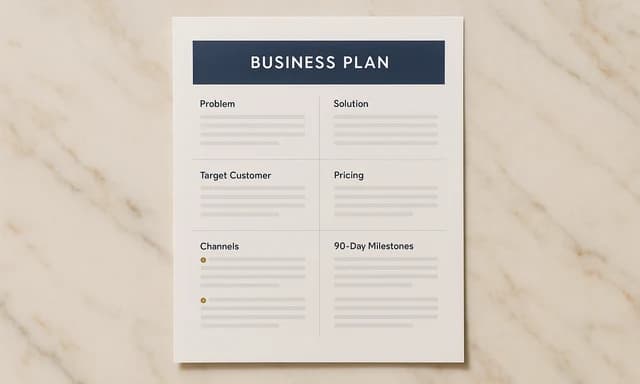
One-page business plan
Summarize your idea, customers, costs, and next steps.
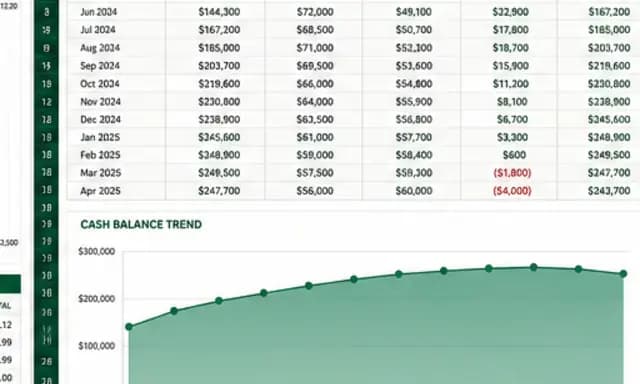
SaaS cash-flow and runway model
Forecast cash flow and runway with editable assumptions and formulas.
Also explore one-page business plan template and SaaS financial model template with 24-month runway scenarios.