Compiled LaTeX report template
Create a LaTeX lab report with methods, figure, and error
Write up your experiment with methods, results, and references.
Make this with my informationOpens an editable creation brief. Nothing runs until you submit.
- Format
- Compiled LaTeX report
- Last updated
- August 31, 2026
- You bring
- 3 inputs
- By
- Huggle Editorial
The creation brief
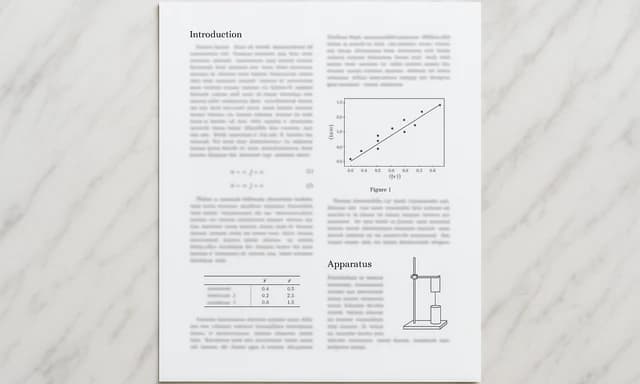
This template is for STEM courses that want a real lab report, not a Word dump. Huggle writes the IMRaD spine and a figure from the measurements you supply.
Creation recipe
Create a LaTeX lab report titled ‘RC Circuit Time Constant.’ Include objective, theory, methods, results with one table and one pgfplots figure, uncertainty discussion, conclusion, and a small marked bibliography. Use only this fictional data: five trials, tau estimates 1.8–2.1 ms. Label data as demo. Ensure it compiles.
What Huggle creates
- IMRaD lab report in editable LaTeX
- Results table, figure, and uncertainty section
- Compiled PDF with marked references
What to bring
- 01Experiment title, methods, and measurements
- 02Required sections or rubric
- 03Approved references
Overview
What is a LaTeX lab report?
A LaTeX lab report is a short scientific write-up of an experiment: objective, methods, results, uncertainty, and conclusion. An AI lab report generator should plot the data you measured, discuss error, and compile to PDF — not invent a cleaner curve than the notebook shows.
What's included
What this AI lab report generator creates
Objective, theory, and methods
Enough theory to justify the measurement, then the procedure you actually ran. The example is an RC time-constant lab. Your methods should match the bench, including instruments and settings.
Results table and figure
Five fictional trials in the example, tau between 1.8 and 2.1 ms, clearly labeled demo. Your figure should use your points. If a point looks wrong, keep it and discuss it — do not let the model smooth it away.
Uncertainty
A lab report without error is incomplete. The template includes an uncertainty discussion. Bring the error rule your course uses (percent difference, standard deviation, instrument precision).
References and compile
A small marked bibliography and a PDF that compiles. Replace citations before you submit to a LMS.
Comparison
Huggle vs. a blank lab-report .tex
Course templates are empty sections. This generator writes methods and a figure from the measurements you provide.
| Criterion | Huggle | Static template |
|---|---|---|
| Starting point | A complete IMRaD draft plus compiled PDF | Section headings in a shared Overleaf project |
| Data | Table and plot from the numbers you supply | You write pgfplots after the due date looms |
| Uncertainty | A required discussion section | Often forgotten |
| Honesty | Demo data labeled; no invented ‘perfect’ curve | Easy to copy a classmate’s plot |
Sources
Sources and benchmarks
- In Nature’s survey of 1,576 researchers, more than 70% had tried and failed to reproduce another scientist’s experiments — a reminder that methods sections and clean data tables matter. Nature, “1,500 scientists lift the lid on reproducibility”
How it works
From example to your finished artifact
- 01
Start from the proven recipe
Open Huggle with the complete creation brief already in the composer.
- 02
Add your context
Answer a few focused questions so the structure, content, and visual direction fit your situation.
- 03
Create and refine
Generate an editable artifact, then ask Huggle to revise it until it is ready to use.
Use the recipe
Make a version that belongs to your work.
Huggle will ask for the missing context, then create an editable latex you can keep refining.
Frequently asked questions
- What is an AI lab report generator?
- It turns your measurements and methods into a compilable LaTeX report. You still own the science and the academic-integrity rules of your course.
- Can I submit this as my lab report?
- Only if it describes work you did and your course allows AI-assisted drafting. Replace every demo number. Cite what you used. Follow the syllabus.
- Will Huggle invent data points?
- The brief allows only the measurements you provide, plus clearly labeled demo data in the example. Do not ship the demo tau values.
- What sections are included?
- Objective, theory, methods, results, uncertainty, conclusion, and a small bibliography — plus one table and one figure.
- Will it compile?
- The brief requires a successful compile. Recompile after you change the figure or packages.
- Is the source editable after it is generated?
- Yes. Fix a caption, add a trial, or ask Huggle to match a rubric.
- What information do I need to bring?
- Bring the experiment title, methods, measurements, rubric or required sections, and approved references.
- How do I use this LaTeX lab report template?
- Open Huggle with the creation brief in the composer, paste your measurements, and submit. Check the figure against your notebook.
Related templates
2 artifacts
Undergraduate thesis
Format your thesis with chapters, figures, references, and a PDF.

Async status research paper
Create a LaTeX research paper with results, citations, and a PDF.
Also explore LaTeX undergraduate thesis template that compiles and LaTeX research paper template that compiles.