Compiled LaTeX thesis template
Create a LaTeX undergraduate thesis that compiles
Format your thesis with chapters, figures, references, and a PDF.
Make this with my informationOpens an editable creation brief. Nothing runs until you submit.
- Format
- Compiled LaTeX thesis
- Last updated
- August 31, 2026
- You bring
- 3 inputs
- By
- Huggle Editorial
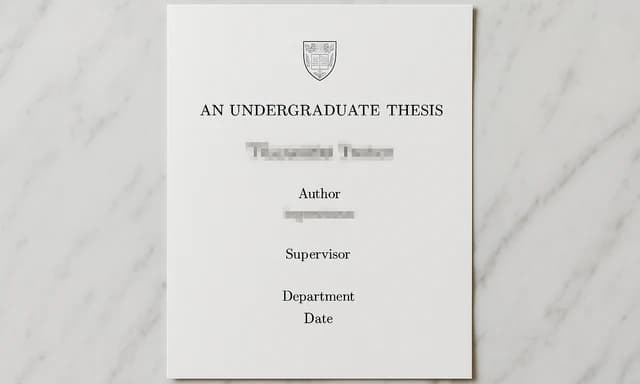
The creation brief
This template is for students who need a thesis that compiles, not an empty class file. Huggle builds chapter structure from your outline and keeps placeholder citations marked.
Creation recipe
Create a LaTeX undergraduate thesis draft titled ‘Async Status and Meeting Load in Student Teams.’ Include title page, abstract, chapters for introduction, background, methods, results, discussion, and conclusion, plus one table, one figure, and a marked placeholder bibliography. Use fictional methods data clearly labeled. Ensure it compiles.
What Huggle creates
- Chaptered thesis in editable LaTeX
- Table, figure, and bibliography placeholders
- Compiled PDF on the first pass
What to bring
- 01Title, program, and chapter outline
- 02Any required university class or format
- 03Verified results and approved references
Overview
What is a LaTeX thesis template?
A LaTeX thesis template is a document class and chapter structure for a long academic paper. An AI thesis generator should return editable source and a compiled PDF with chapters, at least one figure, and a bibliography that does not break the build.
What's included
What this AI thesis generator creates
Front matter and chapters
Title page, abstract, and chapters for introduction, background, methods, results, discussion, and conclusion. That is a standard undergraduate science or social-science spine. Swap chapter names if your department uses a different list.
Table and figure
The draft includes one table and one figure so the build path for floats is proven. Replace the fictional student-team data with your verified results. Do not submit demo numbers as if they were yours.
Bibliography placeholders
Placeholder entries are marked. You replace them with sources you have read. Treat any citation you did not supply as unverified.
Compiled PDF
The first pass should compile. After you change packages or a university class file, compile again in Huggle before you send the PDF to an advisor.
Comparison
Huggle vs. a blank university LaTeX class
Department class files give you empty chapters. This generator fills a compilable draft from your outline.
| Criterion | Huggle | Static template |
|---|---|---|
| Starting point | A chaptered draft plus compiled PDF | An empty .cls with \chapter{} |
| Floats | One table and one figure already in source | You add floats after the prose exists |
| Citations | Marked placeholders, not invented papers | An empty .bib |
| Revision | Ask Huggle to add a chapter or restyle captions | Manual source edits only |
Sources
Sources and benchmarks
- U.S. institutions awarded 58,131 research doctorates in 2024 per the NSF’s Survey of Earned Doctorates — and nearly every one of those careers started with a thesis that had to survive committee review. NSF NCSES, Doctorate Recipients from U.S. Universities: 2024
How it works
From example to your finished artifact
- 01
Start from the proven recipe
Open Huggle with the complete creation brief already in the composer.
- 02
Add your context
Answer a few focused questions so the structure, content, and visual direction fit your situation.
- 03
Create and refine
Generate an editable artifact, then ask Huggle to revise it until it is ready to use.
Use the recipe
Make a version that belongs to your work.
Huggle will ask for the missing context, then create an editable latex you can keep refining.
Frequently asked questions
- What is an AI thesis generator?
- It turns an outline into LaTeX chapters and a compiled PDF. Huggle writes structure and placeholder results; you still write the science and the citations.
- Will this match my university’s thesis class?
- Bring the class name or a sample preamble. The default is a generic article/book-like thesis. You should still check margin and title-page rules.
- Can I use this for a master’s thesis?
- Yes. Add chapters or a literature-review depth in the brief. The compile requirement stays the same.
- Does Huggle invent citations?
- No. Bibliography entries are placeholders you must replace with sources you have actually read.
- Will the thesis compile?
- The brief requires a successful first compile. Recompile after you change citations, figures, or the class file.
- Is the source editable after it is generated?
- Yes. Edit the .tex directly or ask Huggle to rewrite a chapter.
- What information do I need to bring?
- Bring title, program, chapter outline, any required format, verified results, and approved references.
- How do I use this LaTeX thesis template?
- Open Huggle with the creation brief in the composer, replace the demo study with yours, and submit. Review every claim before an advisor sees it.
Related templates
2 artifacts
Async status research paper
Create a LaTeX research paper with results, citations, and a PDF.
STEM lab report
Write up your experiment with methods, results, and references.
Also explore LaTeX research paper template that compiles and LaTeX lab report template with figure and uncertainty.